
How to Search the Rayne Court Docket
Rayne City Court posts a 2026 calendar, not a case-level search database. A name search alone will not pull a file. Gather the citation or case number, the court named on the notice, and the scheduled date. Those details open most inquiries with the clerk. The calendar can only suggest a setting category. For a docket entry, a party, a disposition, or a document, contact the court and ask what public record route exists.
Some Rayne matters belong elsewhere. They are filed through the Fifteenth Judicial District Court and the Acadia Parish Clerk. The path depends on the issuing agency, the charge, the civil amount, and the court of filing. And treat no label as proof. A calendar label alone does not confirm a party match, an outcome, a document image, or a current payment status.
- Read the Rayne citation, summons, or order for the court name, case or citation number, and appearance instruction.
- Check the official Rayne calendar for the relevant setting category and possible date.
- Use the Rayne contact route to confirm the current setting, court file, or payment condition.
- Ask whether the Rayne case remains in city court or was filed in the Acadia district-court system.
- Request the exact Rayne docket, minute, or copy needed after the custodian identifies the file.
Rayne Calendar Setting Labels
Rayne's published 2026 calendar splits its settings into seven labels. They are Civil, City Arraignments, City Trials, State Arraignments, State Trials, Revocations, and Juvenile Traffic. Those categories help you plan date and setting research. They stop there. No case numbers, party names, document images, or account of what happened appear on the calendar. That goes for any Rayne hearing.
For current setting categories and posted times, rely on the official Rayne court calendar on the court's own site.
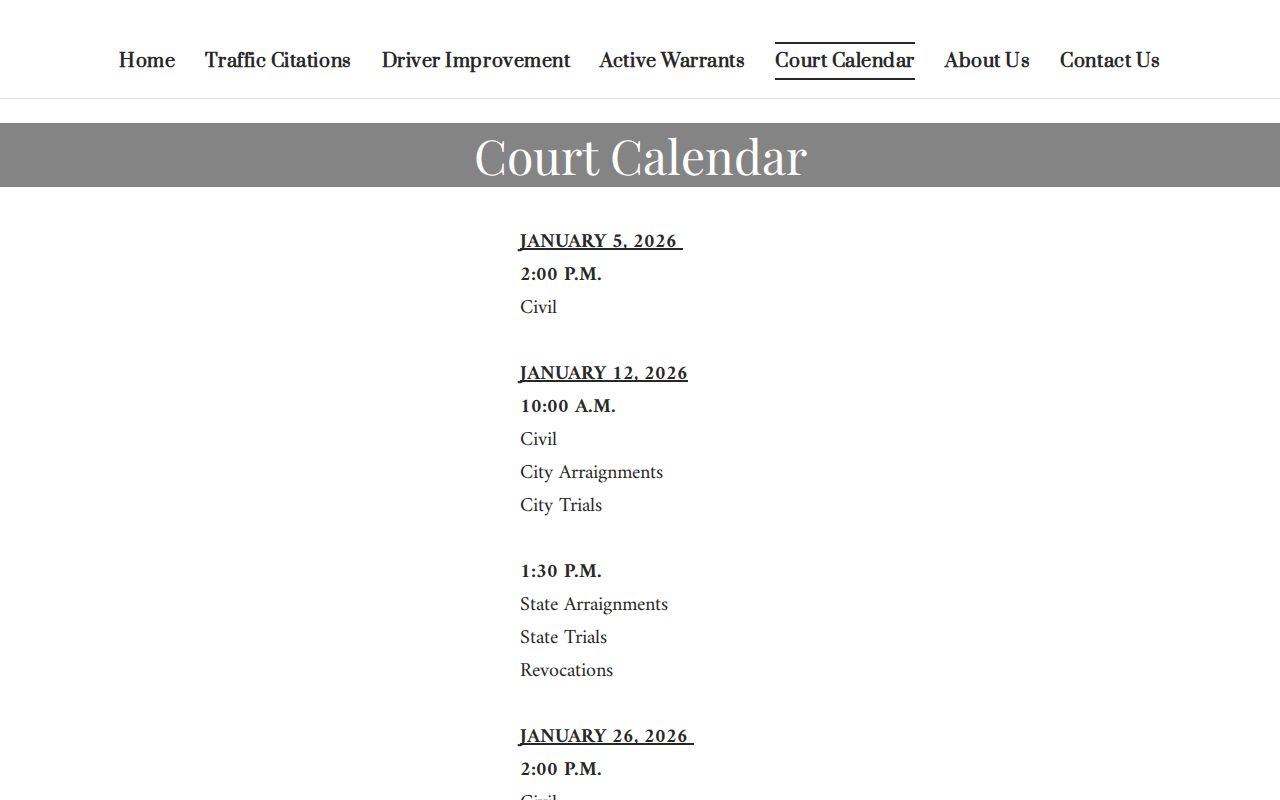
A Rayne calendar entry is a schedule cue. Nothing more. Follow up with the court to learn whether a particular matter is active, reset, continued, or changed in some other way. Keep Rayne's local terms exactly as written. A City Arraignment label means one thing in Rayne, while a similar phrase on a Fifteenth Judicial District Court schedule may describe a different process.
The Rayne Municipal Court
Rayne City Court sits at 301 East Louisiana Avenue, Rayne, Louisiana 70578. Mail goes to P.O. Box 31, Rayne, Louisiana 70578. The listed phone is 337-334-9677; the listed fax is 337-334-9626. Posted Rayne hours run Monday through Friday, 8:30 a.m. to noon and 1:00 p.m. to 4:00 p.m. The court closes on weekends. Call ahead before visiting or mailing a time-sensitive filing.
The official Rayne site identifies Judge Luke A. Beslin, Marshal Stacy Ancelet, and Yvette W. Salvatierra as clerk and public-records custodian, with deputies assigned to traffic, criminal, juvenile, fines, warrants, bonds, and civil work. Names and assignments shift over time. Check the live Rayne court site before relying on a name or office assignment.
For the court's contact, personnel, and history details, the official Rayne visit page is the source.
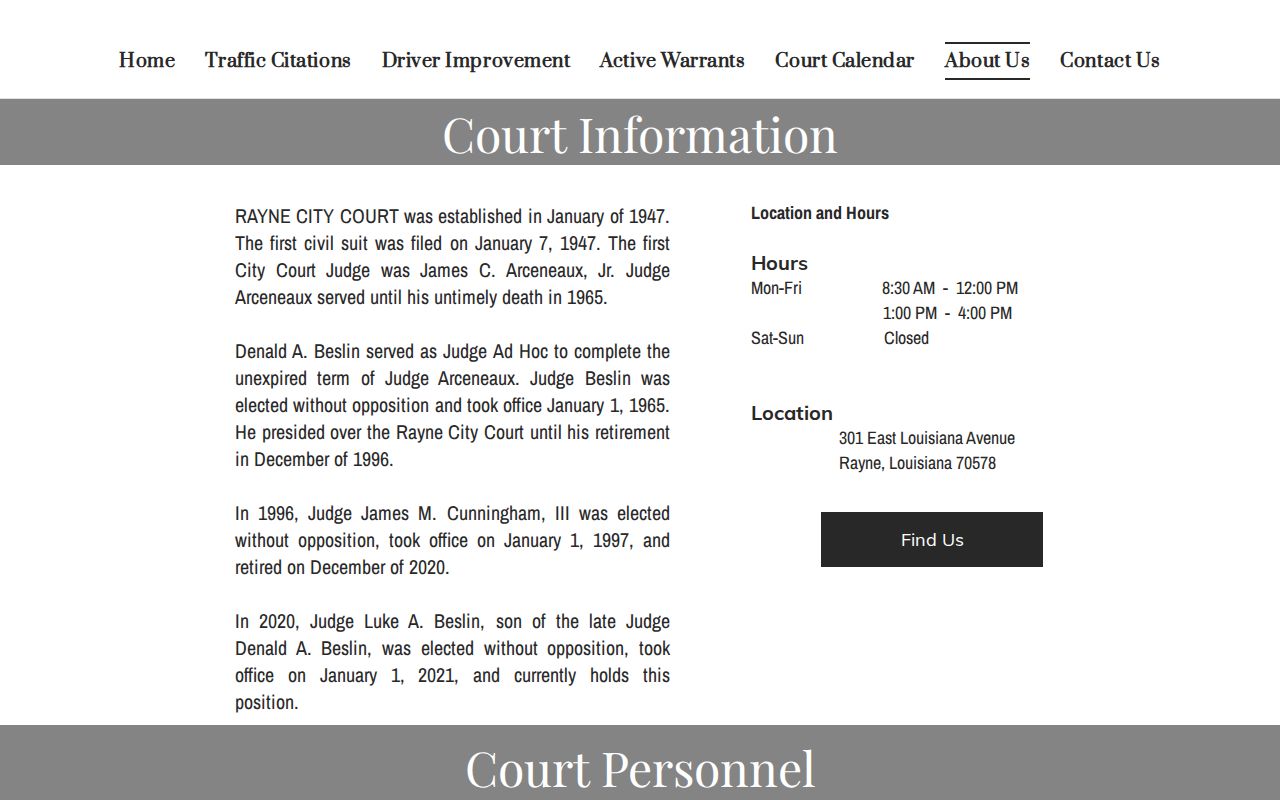
Knowing the Rayne court location helps you find the right local office. That alone is not enough. A civil or criminal case must still be matched to the court shown on its filing or citation.
Rayne Citation Contact Details
The Rayne City Court contact form asks for five fields: Name, Citation Number, Email, Phone, and Message. Use it for a citation or court-matter inquiry. The form is not a docket-search tool. It does not promise a record by email. State what you seek, such as a current date, a payment instruction, a docket entry, a minute, or a copy. Vague requests slow things down. When a caller needs to transmit a citation number or follow up on a Rayne matter, the official Rayne contact form is a useful channel.
Treat any reply as a confirmation step. The court remains the source for the current setting, mandatory appearance status, and record-access limits on Rayne records.
Rayne Court Dates and Settings
Rayne posts dates, times, and setting labels. Civil settings carry multiple times, including 2:00 p.m. and some morning slots. Juvenile Traffic entries appear at 4:00 p.m. on set dates. City and state arraignments and trials each get their own Rayne calendar label. A posted time is no promise. Cases get continued or reset after publication. A court closure or a later order can also change a published date. Before you appear, confirm the setting with the court. The best request names the case or citation. It also asks for the setting type, and whether attendance is still required.
| Date | The Rayne calendar date for the posted civil, city, state, revocation, or juvenile-traffic setting. |
|---|---|
| Time | The Rayne time tied to the setting category, which can vary between civil and juvenile-traffic entries. |
| Court | Rayne City Court for the local published calendar, not a Fifteenth Judicial District Court division. |
| Setting Type | Civil, City Arraignment, City Trial, State Arraignment, State Trial, Revocation, or Juvenile Traffic. |
| Current Status | Confirm directly because the Rayne calendar does not report a case result, reset, or continuance. |
Rayne City and State Settings
Rayne runs city and state labels on one calendar. City Arraignments and City Trials are not the same as State Arraignments and State Trials. Each label marks a separate local setting category. Keep them apart. The calendar is a schedule, not a case history, so a label alone cannot tell you who appeared or how a Rayne matter ended. Crowley prints city and state docket labels too. Its labels and times differ from Rayne's. Use Rayne's own vocabulary when you call, rather than another city court's calendar rules. That matters most with a citation. It may demand a specific Rayne appearance or give a local payment instruction.
Rayne Traffic Tickets
Start with the ticket itself. A Rayne citation carries the citation number, the issuing agency, the alleged violation, the court date, and any appearance instruction. Those details belong together in one place. Where the case lands depends on the agency, the offense, and the jurisdiction. So a ticket written in Rayne may still belong with a different court or clerk. Trust the notice over any general guess about Acadia traffic records.
Rayne City Court lists its payment methods. They are money orders, cashier's checks, credit and debit cards, and cash. Personal checks are not accepted. Payment must be made in full before the scheduled appearance. Otherwise, the person appears on that date. Online payment works only where no mandatory appearance applies. Call Rayne City Court before relying on any payment route for a specific citation.
Rayne Payment and Appearance Rules
Rayne draws a firm line between a payable ticket and one that demands a court appearance. Never mail a personal check. Never assume the online option is open. Paying is never a substitute for a mandatory Rayne date. Mail can go to P.O. Box 31, Rayne, Louisiana 70578, while the courtroom address for in-person matters is 301 East Louisiana Avenue.
Rayne ticket route: citation review › confirm court and mandatory appearance › use a listed Rayne payment method only if eligible › obtain current setting confirmation.
District traffic cases in Acadia work differently. The Clerk files the citation but sets no fines and collects none. The collecting office may instead be the sheriff of the parish. That is the parish where the issuing agency sits. So leave Rayne's city payment rules behind when the citation runs through district court.
Where Rayne Cases End Up
Rayne City Court handles local matters. Its docket covers municipal issues, state misdemeanors, traffic, civil claims, and related subjects. Those sit within its jurisdiction. The civil ceiling is $35,000, set by Louisiana Code of Civil Procedure Article 4843. Anything above that limit, or any felony or district matter, takes another route. Those cases generally go to the Fifteenth Judicial District Court and the Acadia Parish Clerk.
Docket flow: Rayne City Court › Acadia Parish court offices › Fifteenth Judicial District Court › Louisiana Third Circuit Court of Appeal when the proper appeal route applies.
Appeals create split records. The originating clerk keeps one file, and the appellate court keeps its own, so a Rayne or district docket may show an appeal notice without being the full appellate register. For the parish-wide picture, see the Acadia Parish court docket overview.
Rayne Dates Do Not Show Results
A Rayne calendar lists a date, a time, and a setting type. That is all it lists. Party names, case metadata, document images, and dispositions are absent. A trial line does not prove a trial happened. A revocation line does not prove any result. The court or records custodian must confirm a particular Rayne case event.
For a fuller docket request, gather the Rayne case or citation number. Add the record type and the date range. A complete docket can include event entries, settings, court actions, and a disposition. The calendar helps, but it is one layer of the Rayne record path.
A missing Rayne entry usually has a simple cause. First check the request. It should name the right city or state setting, the right date, and the right court. Then ask where the matter sits. It may be Rayne City Court, the Acadia Parish Clerk, or another court entirely. A limited calendar display is not an index of every Rayne filing. Nor can it reveal a document that is restricted or available only through the custodian's record process.
Public Access to Rayne Court Records
Louisiana public-record rules open the door to public Rayne court material. They work through its lawful custodian, subject to exceptions. Inspecting is not the same as receiving a plain copy, a certified copy, a minute entry, or the full file. A focused request should name the court. It should also list the citation or case number if known, plus the record type, date range, and format wanted. Ask the Rayne clerk or public-records custodian which route applies.
Some Rayne records stay closed. Juvenile, sealed, expunged, protected-identity, and confidential files can carry access limits. A blank online result or a bare calendar label does not mean no Rayne case exists. It may signal a restricted record. It may also point to a case not published online, or to the need for a narrower request.
Louisiana public-access rules.
Louisiana R.S. 44:1 defines public records broadly, while recognizing legal exceptions.
Louisiana R.S. 44:31 provides for inspection or copying unless an exception governs the record.
La. C.C.P. 251 identifies the clerk as custodian for court-record examination and certified copies.
Rayne Juvenile Traffic Boundaries
Rayne's calendar includes a Juvenile Traffic setting label. That public label opens nothing. It does not open a juvenile case file. The Acadia Clerk states that juvenile filings are confidential absent a valid court order, and that caution holds whenever a Rayne calendar points to a juvenile setting. Treat a Rayne juvenile date as permission for nothing. Seeking or sharing protected details is not allowed.
For a Rayne juvenile or other restricted record, ask the court or custodian whether a court order, a redacted record, or another lawful process is required. A focused inquiry beats third-party copies and beats guessing from the calendar.
Note: A Rayne calendar is a scheduling resource, while access to a protected court file is controlled by law and the record custodian.